
AESTHETIC FACIAL
THREAD LIFT
Thread Lift at NURIM Dermatech is a personalized aesthetic treatment designed to support facial lifting, skin tightening and improved facial contours.
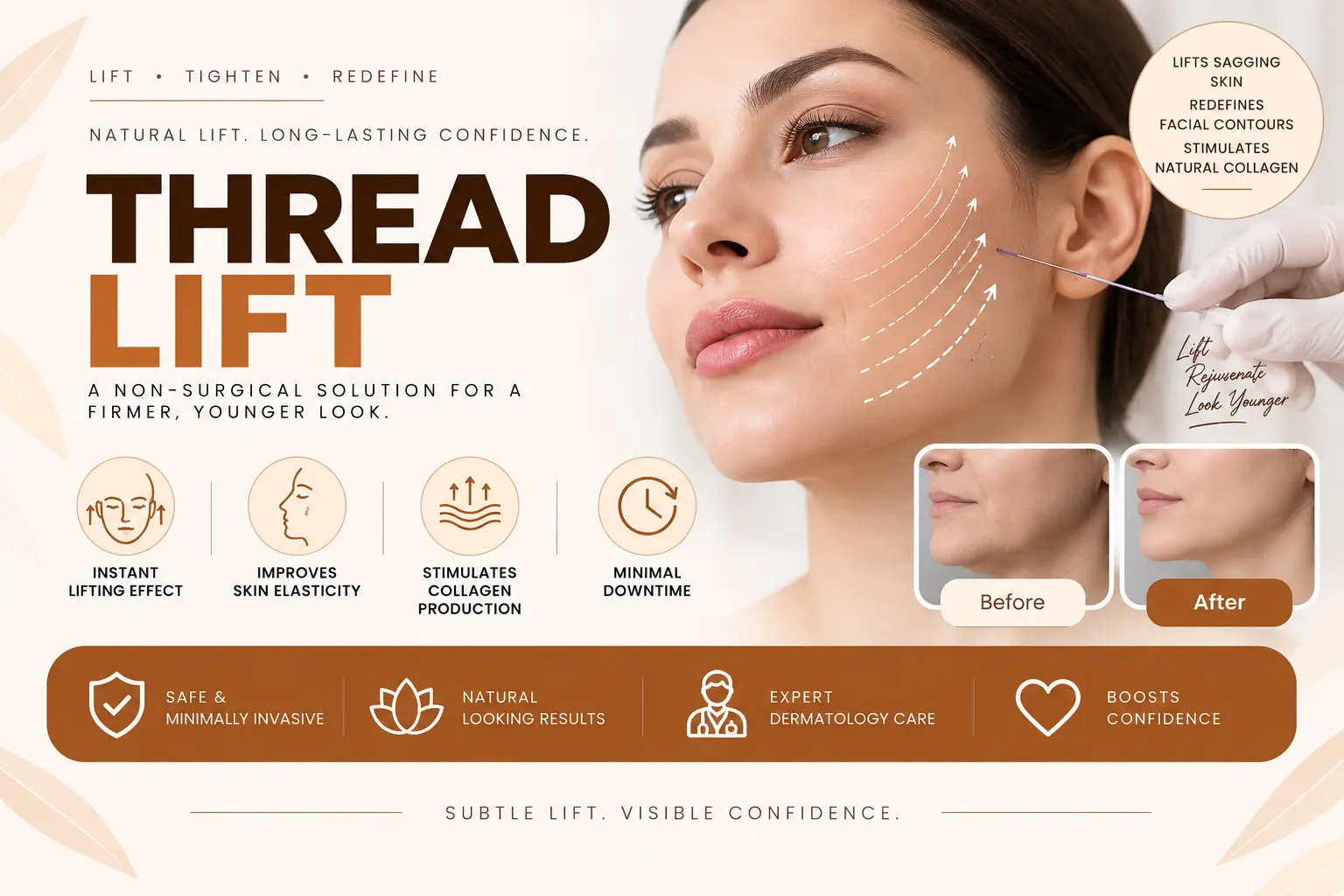
A Thread Lift is a refined, minimally invasive facial rejuvenation treatment designed to restore definition, elevate gently relaxed tissues, and refresh the overall architecture of the face – without the incisions associated with conventional facelift surgery. True facial rejuvenation is not about changing the way you look – it is about restoring the harmony, structure and definition that time gradually softens.
Nurim approach is individually planned around your facial anatomy, skin quality and aesthetic goals. Strategic thread placement can help enhance the jawline, lift the cheeks, improve facial contours and create a more rested appearance. As the threads gradually stimulate collagen formation, the treatment can also contribute to progressive improvement in skin firmness and texture.
WHY CHOOSE A THREAD LIFT?
✓Subtle lifting and facial rejuvenation
✓Enhanced jawline and facial definition
✓Improved cheek and mid-face contour
✓Helps address mild to moderate skin laxity
✓Collagen-supporting effect over time
✓Minimally invasive alternative to surgical lifting
✓No major surgical incisions
✓Designed for natural-looking results
✓Individualised treatment planning
AREAS THAT CAN BE TREATED:
Thread lift may be considered for –
✓Cheeks and mid-face
✓Jawline
✓Lower face
✓Jowls
✓Nasolabial region
✓Brow area, in selected cases
✓Neck, depending on skin laxity and individual suitability
TREATMENT PROCEDURE OF THREAD LIFT:
At nurim, every Thread Lift is approached as a personalised facial-architecture procedure. The treatment is carefully planned according to your anatomy, degree of laxity, skin quality and desired aesthetic outcome.
Step 1: Comprehensive Facial Assessment-
Your treatment begins with an in-depth consultation and facial assessment. Our aesthetic specialist evaluates facial proportions, skin laxity, tissue descent, volume distribution and areas requiring structural support.
Step 2: Customized Treatment Mapping –
Strategic entry and thread-placement points are mapped on the face according to the individual’s anatomy and treatment goals. The number, type, and positioning of threads are selected based on the area being treated and the degree of correction required.
Step 3: Preparation & Local Anaesthesia –
The treatment area is thoroughly cleansed and prepared under strict protocols. Local anaesthesia is administered at the relevant entry points to ensure maximum comfort during the procedure.
Step 4: Precision Thread Placement –
Using specialized techniques, the absorbable medical-grade threads are introduced through carefully selected entry points beneath the skin. The threads are positioned along predetermined vectors to provide controlled support and subtle elevation of the targeted tissues.
Step 5: Sculpting & Contouring –
Once positioned, the tissues are gently repositioned to enhance the desired facial contours. Particular attention is given to symmetry, facial proportions and the preservation of natural expressions.
Step 6: Final Assessment –
After placement, the treatment area is carefully assessed from multiple angles to ensure appropriate balance and symmetry. The threads are secured and the entry points are managed according to the treatment protocol.
Step 7: Personalised Aftercare –
A detailed post-treatment instructions designed to support healing and protect the treatment result. Mild swelling, bruising, tenderness or temporary tightness may occur following treatment.
BENEFITS OF THREAD LIFT:
Thread lift is designed for individuals seeking a subtle yet visible improvement in facial definition without undergoing conventional facelift surgery – creating results that look refreshed, elevated and beautifully natural.
Benefits are –
✓Subtly lifts and repositions sagging facial tissues
✓Defines and sharpens the jawline
✓Reduces the appearance of early jowling
✓Enhances cheek and mid-face contours
✓Improves the appearance of mild to moderate skin laxity
✓Supports natural collagen production and tissue remodelling
✓Improves skin firmness and overall facial texture
✓Restores youthful facial proportions and definition
✓Creates a fresher, more lifted appearance
✓Minimally invasive with no major surgical incisions
✓Relatively shorter recovery than surgical facelift procedures
✓Preserves natural facial movement and expression
✓Delivers refined, natural-looking rejuvenation
ADVERSE EFFECTS OF THREAD LIFTS:
Thread lift is a minimally invasive procedure, but – as with any medical aesthetic treatment – it can involve temporary side effects such as –
Mild swelling and puffiness
Bruising or temporary redness
Tenderness, soreness or discomfort
Temporary tightness or pulling sensation
Mild asymmetry during the healing phase
Temporary skin dimpling or irregularities
Palpability or visibility of the thread in some cases
Temporary numbness or altered sensation
Minor bleeding at the entry points
Infection, although uncommon
Rarely - Thread migration, breakage or extrusion
Rarely - Delayed healing or prolonged inflammation
Very Rarely - Injury to nearby nerves or blood vessels
CONTRAINDICATIONS OF THREAD LIFT:
Thread lift is not suitable for everyone. A thorough medical and facial assessment is essential before treatment to determine suitability and minimize potential complications –
Active skin infection or inflammation in the treatment area
Open wounds, severe acne or significant skin irritation
Active inflammatory or uncontrolled skin conditions
Bleeding or clotting disorders
Current use of anticoagulant or antiplatelet medication without appropriate medical clearance
Known allergy or hypersensitivity to the proposed thread material or local anaesthetic
Poor wound healing or significant scarring tendency
Uncontrolled systemic medical conditions
Pregnancy or breastfeeding
Severe facial skin laxity or advanced tissue sagging
Significant untreated facial asymmetry or volume deficiency requiring another treatment approach
Unrealistic expectations regarding the achievable results
Recent facial surgery regarding the achievable results
Recent facial implants or altered anatomy requiring specialist assessment
Inability to follow post-treatment care instructions
FAQs:
1. What is a Thread Lift?
A minimally invasive treatment using absorbable threads to lift, support and contour facial tissues.
2. Which areas can be treated?
Cheeks, Mid-face, Jawline, Jowls, Lower face and selected areas of the neck or brow.
3. Is a Thread Lift painful?
Local anaesthesia is used, making the procedure generally comfortable.
4. How long do results last?
Results vary depending on the thread type, skin quality and individual response.
5. Is there any downtime?
Mild swelling, bruising, tenderness or tightness may occur during recovery.
6. How is a thread lift different from a facelift?
A thread lift is minimally invasive, while a facelift is a surgical procedure offering more extensive correction.
7. Can thread lift improve the jawline?
Yes. Strategic thread placement can enhance jawline definition and improve the appearance of early jowling.
8. Are Thread Lift results immediate?
An initial lifting effect may be visible immediately, while the final appearance develops progressively as healing occurs.
9. Are these scars after a Thread Lift?
The procedure uses small entry points, which generally heal discreetly with minimal visible scarring.
10. Does everyone get the same number of threads?
No. The number and type of threads are customized according to your anatomy and treatment objectives.
11. Can a Thread lift improve facial symmetry?
It may help refine certain areas of asymmetry, depending on the underlying cause and individual anatomy.
12. Can Thread Lift reduce jowls?
It can improve the appearance of mild to moderate jowling by providing support and repositioning selected tissues.
13. Can Thread Lift define the chin and jawline?
Yes, strategic placement may enhance lower-face definition and create a more sculpted contour.
14. Can Thread lift be performed with fillers or Botox?
Potentially yes. Combining treatments may be appropriate in selected patients, with timing determined by the treating clinician.