Category: Skin
SKIN
ACNE SCAR TREATMENT
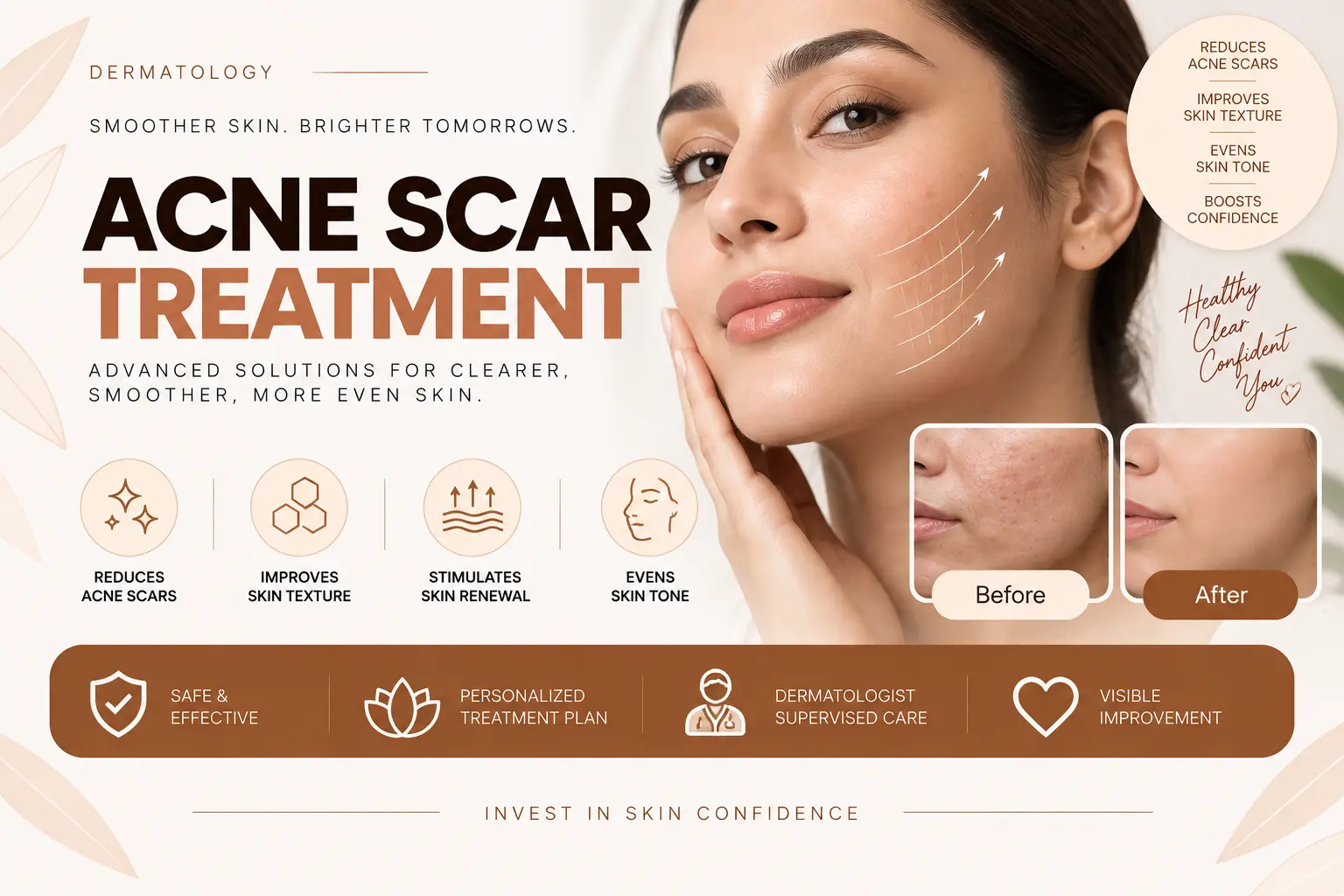
Acne Scar Treatment at NURIM Dermatech is a personalized dermatological approach designed to improve the appearance of acne scars, uneven skin texture and post-acne skin concerns.
“Beautiful skin is not about erasing your history – it’s about revealing the healthiest, most refined version of your skin today.”
Acne scars are more than a reminder of past breakouts – they can alter the texture, tone and overall harmony of the skin. Acne may fade, but the marks and scars leave behind can remain long after the active breakouts have disappeared. Nurim acne scar treatment is approached as a process of skin remodelling and regeneration, than simply surface correction. Nurim objective is to stimulate controlled skin renewal, encourage collagen remodelling and progressively soften the appearance of scars – while maintaining the natural character of your complexion.
Every complexion tells a different story. Some scars are shallow and rolling, while others are deeper and more defined. Pigmentation may coexist with textural irregularities, and the skin may also exhibit sensitivity or compromised barrier function following years of acne. So, nurim focused on measured, progressive improvement, adapting your treatment plan according to how your skin responds at every stage.
TREATMENT PROCEDURE OF ACNE SCARS
At nurim, every acne scar treatment is thoughtfully customised according to scar type, depth, skin tone, pigmentation and overall skin condition. The treatment focuses on controlled skin renewal and progressive collagen remodelling for a smoother, more refined appearance.
01
Step 1: Comprehensive Skin Assessment – Your skin is carefully evaluated to identify the type and severity of acne scars, including rolling, boxcar and ice-pick scars, along with pigmentation, enlarged pores and uneven texture.
02
Step 2: Personalised Treatment Planning – Based on the assessment, a customised protocol is created. Depending on your skin requirements, this may include fractional laser, RF microneedling, microneedling, subcision, chemical peels, PRP or other regenerative approaches.
03
Step3: Skin Preparation – The skin is thoroughly cleansed and prepared. Sa topical numbing cream may be applied before procedures such as microneedling, RF microneedling or subcision to enhance comfort.
04
Step 4: Precision Scar Treatment – The selected technology or technique is carefully performed over the affected areas. Controlled micro-injuries, thermal energy or targeted scar-release techniques may be used to stimulate collagen remodelling or improves irregular skin texture.
05
Step 5: Regenerative Enhancement – Where clinically appropriate, regenerative treatments such as PRP may be incorporated to complement the primary procedure and support the skin’s natural repair process.
06
Step 6: Soothing & Skin Recovery – After treatment, calming and restorative skincare is applied to help comfort the skin and support recovery. Sun protection and a tailored post-treatment skincare regimen are recommended.
07
Step 7: Progressive Review – Your skin response is reviewed at follow-up appointments. Treatment intervals and subsequent sessions are adjusted according to healing, scar response and the desired level of improvement.
BENEFITS OF ACNE SCARS TREATMENT
A personalised acne scar treatment programme is designed to progressively improve the appearance and quality of scarred skin, while supporting the natural collagen renewal. The benefits are as follows –
✓
Reduce the appearance of acne scars
✓
Improves uneven skin texture
✓
Softens depressed and rolling scars
✓
Refines the appearance of enlarged pores
✓
Stimulates collagen production
✓
Improves skin firmness and elasticity
✓
Helps reduce post-acne pigmentation
✓
Promotes a more even-looking skin tone
✓
Enhances overall skin smoothness
✓
Restores a healthier-looking complexion
✓
Improves skin luminosity and radiance
✓
Supports progressive skin regeneration
✓
Creates a smoother, more refined appearance
✓
Enhances overall skin quality
ADVERSE EFFECTS OF ACNE SCARS TREATMENT
Acne scar treatments are carefully tailored to minimise downtime and complications, temporary skin reactions can occur as part of the healing and collagen-remodelling process. The intensity and duration on the treatment modality, skin sensitivity, scar severity and individual healing response.
Most reactions are temporary and manageable with appropriate post-treatment care like –
- Temporary redness
- Puffiness
- Treated area may feel warm, tender or sensitive
- Mild dryness, flaking or superficial peeling may occur
- Small areas of bruising occur
- Hyperpigmentation or hypopigmentation may develop
- Temporary breakouts
- Abnormal scarring depending on the procedure and individual healing response
CONTRAINDICATIONS OF ACNE SCARS
Acne scar treatment is not suitable for everyone at every stage. A thorough skin assessment is essential to determine whether treatment is appropriate and which procedure is safest for your skin.
- Active or severe acne breakouts
- Active skin infection, open wounds or inflammation
- Active herpes or other infectious skin conditions in the treatment area
- Uncontrolled eczema, psoriasis or other active inflammatory skin conditions
- Known tendency to develop keloids or hypertrophic scars
- Poor wound healing or certain uncontrolled medical conditions
- Recent use of medications that may increase skin sensitivity or affect healing
- Use of photosensitising medications
- Pregnancy or breastfeeding
- Known allergy, hypersensitivity to any product or medications
- Recent excessive sun exposure or active sunburn
- Patients unable to follow required pre – and post-treatment care
FAQs
01
Can acne scars be completely removed?
Significant improvement is possible, but complete removal cannot always be guaranteed.
02
Which acne scars can be treated?
Rolling, boxcar and certain ice-pick scars can be treated with customised procedures.
03
How many sessions are required?
Most patients require multiple sessions for progressive improvement.
04
Is there any downtime?
Downtime varies by treatment and may include temporary redness, swelling or peeling.
05
Can treatments be combined?
Yes. Combination treatments may be recommended for different scar types.
06
Can old acne scars be treated?
Yes, longstanding scars can.
07
Can deep acne scars be treated?
Yes, deeper scars may require specialised or combination treatments.
08
Can large pores be improved?
Certain treatments can reduce the appearance of enlarges pores.
09
Can acne scars be treated on darker skin tones?
Yes, with carefully selected treatments and appropriate settings.
10
Is consultation required before treatment?
Yes, a detailed skin assessment helps determine the appropriate protocol.
11
Does treatment improve skin firmness?
Collagen-based treatments may improve the appearance of firmness and elasticity.
12
Will results look natural?
The aim is gradual improvement while preserving your natural appearance.